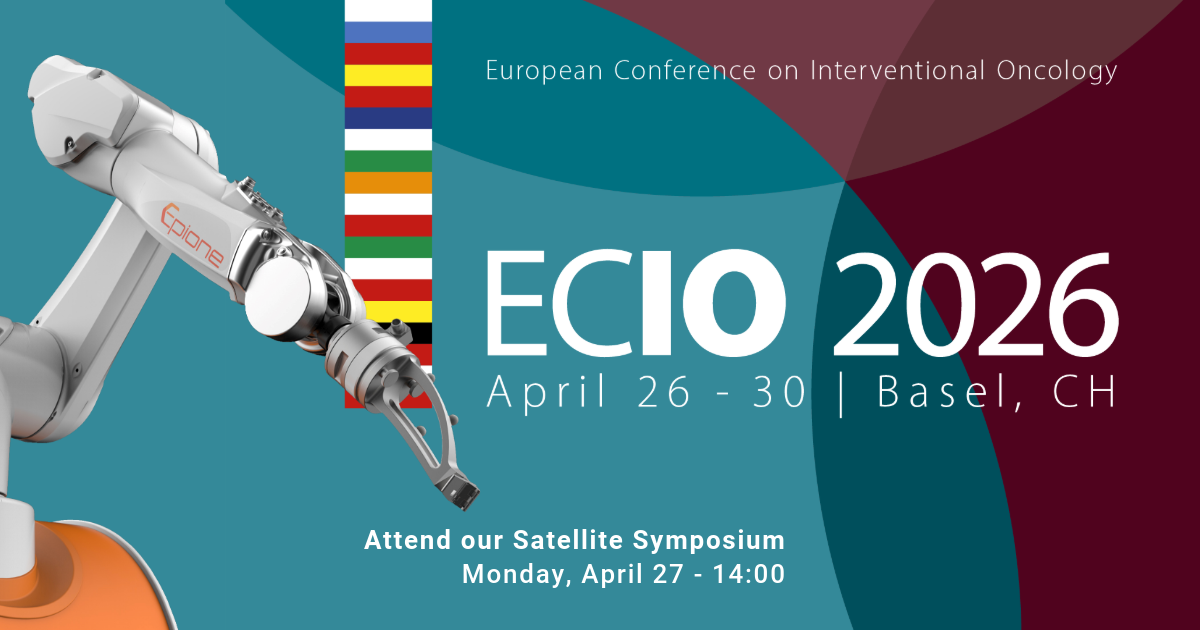
ECIO 2026, April 26-30

The European Conference on Interventional Oncology 2026 will be held in Basel, Switzerland, from April 26 to 30, 2026.
Organized by the CIRSE, this yearly event brings together interventional radiologists, medical oncologists, surgeons, and numerous other healthcare professionals around the latest advancements in Interventional Oncology. The European Conference on Interventional Oncology continues to serve as the global home for those pioneering the future of minimally invasive cancer care.
Don’t miss the opportunity to learn more about Epione®at ECIO:
- Satellite Symposium - More information to come!
- Monday, April 27 - 14:00
- Auditorium 2
- Hands-on Workshop - HDT-TA 25.1 Tumour ablation: confirmation software
- Monday, April 27 - 17:00-18:30 - More information to come!
- Tuesday, April 28 - 8:30-10:00 - More information to come!
EVENT DETAILS
- Date: April 26-30, 2026
- Venue: Congress Center Basel - Basel, Switzerland
Last news
Quantum Surgical Acquires NeuWave Medical, Inc.
Miami, Florida, and Montpellier, France, February 24, 2026 – Quantum Surgical, a company specializing in minimally invasive robotic-assisted cancer treatment, today announced the acquisition of NeuWave Medical, Inc., a medical device company whose products are used by physicians in over 70% of the top cancer centers in the United States. This acquisition supports Quantum Surgical’s strategy to democratize robotic-assisted tumor ablation treatments to reduce cancer mortality.
Quantum Surgical and NeuWave Medical, Inc. – both of which share an extensive focus on innovation to improve cancer patients’ outcomes – will operate as subsidiaries of Precision IO Group Inc., the newly created parent company led by medtech veteran Kurt Azarbarzin, who was recently appointed CEO.
The group’s ambition is to become a leader in the interventional radiology industry, with a strong focus on precision and remote procedures.
Quantum Surgical specializes in robotics and AI and has developed the Epione® robotic platform for treating early-stage tumors. Epione assists physicians in performing percutaneous tumor ablations, where one or more needles are inserted through the skin to treat the tumor.
“At Quantum Surgical, we are committed to democratizing procedural know-how through robotics, and expanding high-quality cancer care for patients. Acquiring NeuWave Medical, Inc. is a natural and strategic step in that mission” said Bertin Nahum, President and co-founder of Quantum Surgical. “Innovation is our north star and we are thrilled to join forces with a passionate team of experts to drive innovation even further and shape the future of interventional oncology.”
NeuWave offers market-leading, clinically proven microwave ablation technology that provides a physician-friendly workflow during percutaneous ablations and is used in 70% of the top cancer centers in the USA.
“We’re proud to join the Quantum Surgical team and continue supporting physicians in their mission to treat cancer patients,” said Leah Kissling, President of NeuWave Medical, Inc. “We look forward to combining our capabilities with Quantum Surgical to drive innovation and help transform the future of cancer care.”
Innovation at the Core: Expanding Cancer Care Through Remote Procedures
The two companies rely on purpose-driven, highly experienced teams committed to transforming cancer treatment through consistent, globally recognized innovation. Bringing the two entities together was a natural step toward creating a new innovation dynamic and an expanded market presence.
Precision IO Group Inc. is already working to break down geographical barriers by enabling remote interventions. The new remote interventions project aims to expand access to robotic-assisted percutaneous procedures by leveraging world-renowned experts for remote trajectory planning and results assessment, using Epione tools.
Enabling remote interventions benefits all stakeholders: more patients can access top-tier physicians and minimally invasive care without traveling long distances. Physicians will be able to extend their expertise with greater geographic reach, collaborate in real time with specialists worldwide, and perform highly precise procedures with enhanced visualization and control.
Medtech Leader Joins as New Group CEO
Seasoned Medtech leader Kurt Azarbarzin has been appointed to lead the new entity, Precision IO Group Inc. He is the former Founder and CEO of SurgiQuest, Inc., a medical device company focused on advancing minimally invasive surgery, and also served as CEO of EndoQuest Robotics and Verb Surgical, a robotic joint venture between Johnson & Johnson and Google. Most recently, Mr. Azarbarzin became a Partner at Frazier Healthcare Partners, where he advises and supports high-growth healthcare companies at critical stages of development and commercialization.
“I am excited and honored to join Precision IO Group Inc. as CEO,” said Kurt Azarbarzin. “Quantum Surgical and NeuWave Medical, Inc. are highly complementary and share an incredible vision for the future. I have met both teams and am impressed by the pride and passion they bring to their work to improve patient care. I believe that their technologies, both independently and combined, have the potential to position us as leaders of the industry, and to transform cancer care on a global scale. Drawing on my 40 years of experience in minimally invasive surgery, I am convinced that AI, robotics and enabling remote interventions are game-changers for cancer care and interventional radiology.”
“Quantum Surgical is expanding fast and will grow even faster with the acquisition of NeuWave Medical, Inc.. We are excited to count on Kurt’s experience and leadership to take us to the next phase for our company,” says Bertin Nahum, President and co-founder of Quantum Surgical.
Guaranteed Business Continuity
While their activities complement each other and robust, cross-organizational enhancements are being developed, both companies will continue to operate independently to ensure a smooth and uninterrupted experience for their users:
- The Epione robotic solution remains an open-architecture platform compatible with common CT imaging and tumor ablation modalities, allowing physicians the flexibility to treat distinct tumor morphologies.
- The market-leading, clinically proven microwave ablation technology developed by NeuWave Medical, Inc. is minimally invasive and can be used independently or combined with other therapies to improve patient outcomes and will remain available to physicians and patients.
Physicians’ workflow and practice, therefore, remain unchanged.
The Epione device is CE marked for abdominal, chest, and musculoskeletal structures indications, and FDA cleared for the abdominal ablation indication. To date, more than 1,400 patients have already been treated in Europe and the United States.
The acquisition and combined growth is fueled by Investment from Ally Bridge Group, the largest investor in Precision IO Group. In connection with the transaction, Stifel acted as exclusive financial advisor to Quantum Surgical. McDermott Will & Schulte LLP served as Quantum Surgical’s legal advisor.
Quantum Surgical at the heart of a €23.9 million European project for precision cancer treatment
· Quantum Surgical is part of the PreciseOnco public-private partnership that unites experts from industry, research organizations, medical societies and leading European hospitals.
· Co-funded by the EU’s Innovative Health Initiative(IHI), the research consortium will combine advanced medical imaging, robotic guidance technologies, and AI to standardize and enhance the precision of minimallyinvasive cancer treatments
· Five-year research program includes five clinical studies to validate the technical solutions
Montpellier, France – Quantum Surgical today announced that it joined the PreciseOnco consortium, which has been awarded funding from the EU’s Innovative Health Initiative (IHI) to advance precision cancer treatment through the integration of advanced medical imaging, robotic assistance, and minimally invasive therapies. The EUR 14.9 million public funding will be complemented by EUR 9 million in in-kind contributions and additional resources from industry partners, supporting afive-year research and innovation program that also includes five clinical studies.
Quantum Surgical, a company specializing in robotics and AI, is developing the Epione® robotic-assisted percutaneous ablation platform. It assists physicians in planning trajectories, positioning treatment needles, and confirming adequate margins have been taken, in order to facilitate and standardize these minimally invasive procedures. Through this research project, Quantum Surgical will explore how Epione can further support spectral-guided interventional procedures.
“We are extremely excited to take part in the PreciseOnco project and to work alongside such prestigious partners to improve cancer care” says Bertin Nahum, President and Co-founder of Quantum Surgical. “We are delighted that Quantum Surgical’s expertise and capabilities can help enhance the precision of minimally invasive cancer treatments”.
Innovation public-private partnership
The PreciseOnco public-private partnership unites experts from industry, research organizations, medical societies and leading European hospitals:
· Industry partners: Philips, Quantum Surgical, and IGEA.
· Research organization: European Institute for Biomedical Imaging Research (EIBIR)
· Medical society: Cardiovascular and Interventional Radiological Society of Europe (CIRSE).
· Academic partners: University Hospital Cologne (Uniklinik Koeln) in Germany, University Medical Center Utrecht (UMCU) and Leiden University Medical Center (LUMC) in the Netherlands, and two major university hospital networks in France: Assistance Publique–Hôpitaux de Paris (APHP; Hôpital Henri-Mondor) and Hospices Civils de Lyon (HCL).
By uniting Europe’s leading clinical expertise and industry innovation, PreciseOnco aims to set a new benchmark for precision, safety, and efficiency in minimally invasive cancer care.
The rising cancer burden and precision treatment needs
Cancer remains a leading health challenge, with approximately 2.7 million new diagnoses in Europe each year [1] with projections suggesting over 35 million new cancer cases globally by 2050, representing a 77% increase from 2022 [2]. In response to this growing challenge, interventional oncology has emerged as a rapidly evolving discipline that integrates medical imaging, oncology, and minimally invasive treatment approaches [3]. Such treatments - including targeted ablation, radioembolization, and electrochemotherapy - offer advantages over traditional surgery, such as shorter recovery times and fewer side effects; however, their effectiveness strongly depends on the performance of medical imaging and the precision with which physicians can guide instruments to tumors.
Bringing advanced technology into the interventional room
The PreciseOnco consortium aims to develop asuite of integrated technologies designed to take the next leap in precision cancer care. Central to the research and innovation program is spectral imaging, an advanced form of CT and cone-beam CT that captures significantly richer information about tissue composition than conventional imaging, enabling more confident differentiation between tumors, vasculature, and healthy tissue. By analyzing X-rays at different energy levels, spectral imaging enables physicians with greater clarity to see exactly what tissues they are treating.
To complement this advanced imaging technology, PreciseOnco will integrate robotic guidance systems that use real-time imaging data to guide interventional instruments (one or multiple needles) with sub-millimeter precision. The consortium will also look to advance electrochemotherapy, a minimally invasive technique that combines locally administered electrical pulses with chemotherapy to selectively treat cancer tissue, with the aim of maximizing tumor control while preserving surrounding healthy tissue.
Crucially, all these technologies will be powered by AI algorithms designed to enhance image quality, reduce radiation dose, streamline advanced visualization software and provide real time intraprocedural feedback on treatment success. This would allow physicians to confirm that tumors have been fully treated before the patient leaves the operating room.
Clinical studies
The project is structured into multiple work packages covering spectral imaging technology development, AI based image processing, robotic guidance integration, multi-center clinical validation, and health economic assessment. PreciseOnco will conduct five clinical studies spanning multiple cancer types and interventional workflows, ensuring robust validation in real world clinical settings:
· VISTA (Virtual Spectral Imaging for Superior Thermal Ablation Guidance): Evaluating spectral imaging to improve liver, kidney ablation procedures andliver radioembolization.
· SPOT ON (Spectral angiography-computed tomography to Optimize percutaneous Tumor ablation): Assessing spectral CT for better tumor targeting and treatment planning.
· HORA EST HCC 2: Combining thermal ablation with transarterial chemoembolization (TACE) in a single session for improved hepatocellular carcinoma treatment.
· SPECTRA-L (Spectral Performance Evaluation of a CT-Equipped Therapeutic RadiologyAngio Suite in Liver): Testing spectral imaging for transarterial chemoembolization (TACE) procedures.
· LASER (Locoregional therApies Spectral Evaluation of Responses): Develop ingimaging biomarkers to predict treatment success across multiple cancer typesand interventional techniques.
Together, these studies will generate evidence to support the adoption of spectral imaging and robotic guidance across European cancer centers, extending access to advanced minimally invasive treatments to a larger patient population.
The PreciseOnco project website will be available soon at www.preciseonco.eu.
The CORDIS project page for PreciseOnco can be accessed here.
References
[1] European Cancer Information System (ECIS) - jrc_CancerEstimates2022_factsheet.pdf.
[2] WorldHealth Organization (WHO) - Global cancer burden growing, amidst mounting need forservices.
[3] Global Interventional Oncology Market report - Interventional Oncology Market Size and Growth Analysis Report.
This project is supported by the Innovative Health Initiative Joint Undertaking (IHI JU) under grant agreement No. 101252582. The JU receives support from the European Union's Horizon Europe research andinnovation program and life science industries represented by COCIR, EFPIA, EuropaBio, MedTech Europe and Vaccines Europe. PreciseOnco is funded by the European Union, private members, and those contributing partners of the IHI JU. Views and opinions expressed are, however, those of the author(s) only and do not necessarily reflect those of the aforementioned parties. Neither of the aforementioned parties can be held responsible for them.
Leeds Teaching Hospitals NHS Trust Acquires Robotic Platformfor Treating Cancer Tumours And Becomes the Fastest-Adopting Center with more than 25 patients already treated
Leeds and Montpellier, December 4, 2025 – Leeds Teaching Hospitals has acquired Quantum Surgical’s Epione® robotic platform and has become the fastest-growing center in terms of procedures, having already treated more than 25 patients in less than 10 weeks. This innovative technology is used to treat early-stage cancerous tumours.
Quantum Surgical, a company specializing in robotics and AI, develops the Epione® robotic platform. It assists physicians in performing percutaneous tumour ablations, where one or more needles are inserted through the skin to destroy the tumour. This minimally invasive treatment provides patients with a safe and effective alternative to surgery.
Leeds Teaching Hospitals patients have benefited from these percutaneous ablation techniques for over 20 years.
Thanks to Epione, Leeds Teaching Hospitals can now offer patients with liver and kidney cancer this robotic-assisted technology. Patients treated with this new robotics technology can benefit from less post-operative pain, shorter stays in hospital and potentially curative outcomes, recovering at home in a few days.
Paul Woodwards, 67 from Leeds, recently underwent the procedure to treat liver cancer. The tumour in his liver was broken down using the robot-guided procedure and he was able to be home within four days with minimal discomfort. He will now be monitored for up to 10 years to see if the cancer has been successfully treated.
“I feel very lucky to have been offered this procedure. It was brilliant to be at the forefront of such cutting-edge treatment. I was happy to be able to come home and recover within such a short space of time without needing to have a long hospital stay.”
“The staff have been absolutely wonderful, every member of the team has looked after me, checking up on me and reassuring me through my recovery afterwards. I am hopeful that other patients and families facing a cancer diagnosis will be able to benefit from this technology and to have more accurate treatments in the future.”
Dr. James Lenton and his team are convinced of the added value Epione brings, having already treated more than 25 patients. This makes Leeds the hospital with the fastest rollout in performing procedures.
Dr. James Lenton, Consultant Interventional Radiologist at Leeds Teaching Hospitals, explains: “Utilising the Epione system is helping us to deliver care and perform less invasive more precise treatment. This reduces disruption to patients’ wellbeing and gives shorter hospital stays allowing us to manage more cases. We are pleased to have integrated the robot into our practice and to have already treated so many patients with it.”
Dr Magnus Harrison, Chief Medical Officer at Leeds Teaching Hospitals says: “At Leeds Teaching Hospitals, our aim is to offer patients the most advanced and innovative treatments while improving their comfort and overall experience. Acquiring the Epione system is a strategic step in that mission, and we are proud to offer this new therapeutic option to our patients”.
“We are very proud of how quickly the Epione robotic system has been adopted at Leeds Teaching Hospitals. Dr. Lenton and his team’s rapid uptake of the platform clearly demonstrates its added value: it streamlines workflow, enhances precision, and enables the treatment of a greater number of patients. Their leadership sets an example for physicians across the UK” declares Bertin Nahum, President and co-founder of Quantum Surgical.
Epione® device is CE marked for abdomen, chest and musculoskeletal structures indications, and FDA cleared for abdominal ablation indication. Over 1,200 patients have already been treated in Europe and the United States.